How a pandemic, a personal crisis and a spark of rebellion birthed one of Nairobi's most unexpected cultural movements.
Chapter 1: It begins
Straight up, Moov didn't begin as a business plan.
It actually began as a survival thought in the middle of Covid, at a time when nothing in my life felt stable.
I had just moved into a new apartment on Ngong' Road.
I was paying a car loan.
My salary had been cut.
But the real pressure wasn't financial - it was internal.
I felt stuck.
Career-wise, relationships-wise, physically… nothing was moving.
It was one of those seasons where you feel like life is happening to you, not with you.
And while I was battling my own sense of hopelessness, the people around me were also being hit hard.
My mum's company, once one of the most respected travel agencies in Kenya, was collapsing under the weight of closed borders.
My brother's car business was struggling too. Without an office, nobody wanted to take the risk on him.
So as the world fell apart, the three of us did what families do: we tried to build something from the scraps.
They found a small plot in Kilimani.
The plan was simple:
- Set up a car yard
- Add a car wash
- Create space for a barber shop
- Move my mum's travel agency there to cut costs
- Whatever space was left - and it wasn't much, was to become a small restaurant or nyama choma joint.
That tiny leftover space… would eventually become Moov.
At the time, none of us knew what it would turn into.
To me, it was just an opportunity to do something. Anything - to regain direction in a year that had stripped everything down.
But somewhere between my personal crisis and the chaos of Covid, an idea formed in my mind:
What if this little restaurant didn't have to be ordinary?
What if it wasn't just another nyama choma joint thrown into a busy car yard?
What if it could become a space that actually felt alive- creative, expressive, unapologetically Kenyan?
What if it could move with the people?
That's where the concept began.
Not in a boardroom.
Not in a pitch deck.
But in a moment of personal collapse that created unexpected clarity.
Moov was born from that energy;
raw, adaptive and full of motion.
A 40-foot container.
A dream that refused to stay small.
And a belief that even in the darkest seasons, something beautiful can still be built.
Chapter 1.2: The dream meets the budget
Initially, I toyed with the name "The Cube" - drawing inspiration from a really cool restaurant concept I'd experienced in Abuja, Nigeria (if the owners are reading this, HI!). It had this modern, modular, experimental feel, and the name stuck with me. So I began sketching layouts for "The Cube."
And something unexpected happened.
As I designed, I started to come alive again.
For the first time in months, it was easier to get out of bed.
The fog of Covid, failure and hopelessness began to lift.
I poured myself into it.
A double-storey restaurant.
Clean lines.
Glass.
Textures.
A space that felt bold and new.
I sat with an interior designer who turned my sketches into a full visual concept, and when the quotation came back at KES 14–15 million, I didn't even flinch. I was excited. Fired up. Ready.
I called my mum for a meeting, laptop under my arm, heart racing.
I presented everything- the mood boards, the layout, the render, the menu direction, the business logic.
And I will never forget her eyes that day.
She listened quietly from start to finish. There was pride in her eyes… but also a softness. A realism. The look of a parent who has lived long enough to know that dreams collide with life.
When I finished, she smiled and said,
"This looks great. Well done."
Then she paused.
"But we don't have that kind of money."
I tried to negotiate with the universe.
"Okay," I said, "we can remove the upstairs. Simplify a few things. We can knock off 3–4 million. That gets us to 10 or 11 million. That works, right?"
She shook her head gently.
"No. You'll have to go lower than that. What more can we remove?"
Lower?
I had already stripped out my dream's first floor.
But fine - I went further.
"We can redesign the kitchen. Remove the Rational oven. Remove the walk-in chiller. Downgrade some equipment. That brings us to 7 or 8 million."
Then I stopped.
"BUT THAT'S IT. I can't go any lower than that!"
She looked me straight in the face.
Calm. Steady. Unshaken.
And said the sentence that changed everything:
"You have 3 million to work with - 4 at best."
Just like that, The Cube died.
And Moov began.
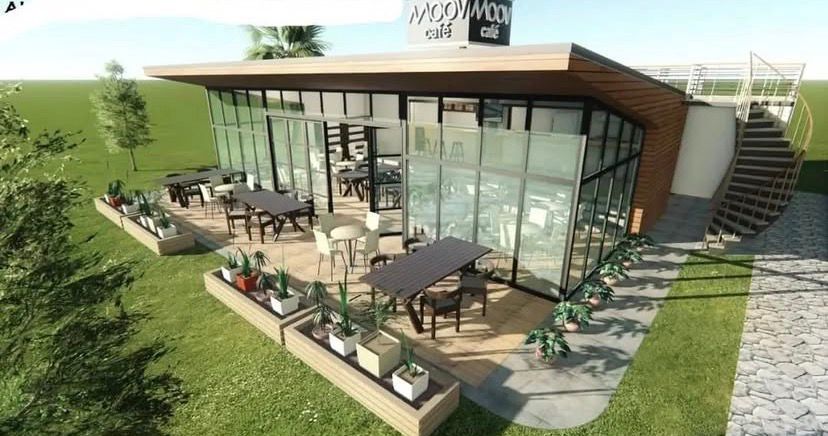
Initial design of 'The Cube' rebranded to 'Moov Cafe'
Chapter 1.3: The Theory of Moov
So there I was - after weeks of planning, drawing, meeting designers and kitchen suppliers, now thinking to myself:
"They're all going to think you're a clown when you go back and tell them you only have 3M to work with."
To put it in context, the kitchen alone would cost 2.5–4 million.
(Yes, commercial kitchens are that expensive in Kenya.)
In my mind I was like,
"WTF am I supposed to do with 3–4 million now?"
I was sulking.
And honestly, quite pissed off.
As I was driving home on Ngong Road, sulking in my air-conditioned Tiguan, three moments happened in quick succession - and they changed everything.
First, I overtook a man riding a Black Mamba bicycle.
Then I passed a lady in a red apron and mushroom chef hat serving customers at a roadside kibanda.
Minutes later, I drove past carpenters building furniture on the roadside.
Those three images collided in my mind and became the foundation of the Moov philosophy.
a) The Moov Blackie
I grew up in Buru.
When I was a kid, I loved riding bikes around the estate. The askari kept his bicycle - a blackie - in our house for safety. I'd climb on it and pretend to ride, making ridiculous motorbike sounds.
One day, the bike disappeared.
My dad told me the askari had travelled home.
Later, when I was older, he explained he used to ride that blackie all the way to Western Kenya to see his family.
On an actual bicycle.
And here I was…
Sulking because my mum wouldn't give me 10 million
while driving a Tiguan
past a man powering his life forward on a blackie.
Perspective slapped me in the face.
b) The Kibanda
It was the look on their faces.
The lady cooking.
The guests eating.
They all looked… content.
Happy. Comfortable. Unbothered.
How was the owner of that kibanda so content running a food business without a Rational oven or an 8-burner stove? Where was she storing her meat when there's clearly no walk-in chiller?
How were people enjoying ugali-nyama or chapo-ndondo so joyfully by the roadside?
My chef instincts and my business instincts clicked at the same time.
(We'll talk more about this when we get to the menu.)
c) The Furniture
I had been exploring furniture stores…
and here were carpenters building pieces from scratch on the roadside.
Raw wood.
Simple tools.
Pure skill.
It hit me:
Why not build all the furniture locally?
Customize it.
Support these guys.
Save money.
Inject authenticity.
Another instinct kicking in… but granted, one I didn't fully understand yet.
I got home, took off my suit, opened a cold one, sat on my couch still sulking and asked myself:
Is it possible to build a restaurant in Kilimani with 3–4 million?
After replaying the Blackie, the Kibanda, and the Roadside Carpenters in my mind…
the answer landed clearly:
Yes.
That shift -
from "too little" to "make do with it,"
from "my mum is being mean" to "I'm a spoilt child who needs to grow up,"
from "I can't" to "I most certainly can" -
…that shift birthed the name, the concept and the soul of MOOV.